Brachypelma

Monday, 13 February 2017

Saturday, 11 February 2017
Fruit Fly Culture Experiment
I started making my own fruit fly culture right from the very beginning. It didn't occur to me that I could by a powdered product off the shelf until I accidentally came across it one day. I thought my only option for buying it was to buy another culture with flies already in it. Fly cultures are expensive, the only place in my city where I have found them charges $14. And they don't always have the type of fly that I want. There are two that are regularly available, the big ones with wings and the smaller ones without. I find the larger flies more useful for most of the things that I feed, and flies without wings are just a little strange. Anyway, months after I started making my own fly culture I tried the powdered repashy stuff. I don't particularly like the smell of it, but it seems to work well. But how well? I have wondered all along if it is any better than my homemade stuff (the recipe is not mine originally, it was an internet find). So I decided to do a simple experiment. I made up a bash of Repashy, according to the instructions, and placed 3/4 of a cup in the bottom of a deli cup, and then thawed out a batch of my own mixture and placed 3/4 of a cup of it in the bottom of another deli cup:

I left them sitting for a few hours so the temperature would be the same. Then I took some of calcium powder that people use to increase the vitamin content of feeders and added flies. This allowed me to subdue the flies long enough to count exactly 20 flies into each culture. Now we wait. My questions are these: is my homemade mixture as mold resistant over the long term, which culture retains moisture better, and which will produce a greater number of flies. Of course I may not have an ideal mixture of males and females in each cup, which could impact the production numbers.
 Update: Well so far the experiment has been a complete disaster. I always thought that the calcium supplement powder was no big deal to fruit flies, that they just cleaned it off themselves and went on happily with life, but apparently it's fairly lethal to them. They all died, in both containers, except for two. So, using the same culture, I am going to throw in a much rougher estimate of 20 or so flies into each one, and try again. Boo.
Update Number 2: Well again this did not goes as expected at all. My home-made culture did very poorly, developing a lot of mold and killing off the flies. This seemed very weird at first, because I use this stuff all the time, and have never had any trouble with mold. I think what's different this time is the small number of flies that I put in. I think the flies themselves, and their use of the culture, prevents the mold from growing. The repashy of course, produced the usual amount of flies. Well, I didn't manage to prove that my home made culture is just as good, which was my intention. Clearly under some circumstances it is not. However, it is what I use most of the time, and it works really well at a fraction of the price, so I will keep using it despite the abysmal outcome of my little experiment.

I left them sitting for a few hours so the temperature would be the same. Then I took some of calcium powder that people use to increase the vitamin content of feeders and added flies. This allowed me to subdue the flies long enough to count exactly 20 flies into each culture. Now we wait. My questions are these: is my homemade mixture as mold resistant over the long term, which culture retains moisture better, and which will produce a greater number of flies. Of course I may not have an ideal mixture of males and females in each cup, which could impact the production numbers.

Update Number 2: Well again this did not goes as expected at all. My home-made culture did very poorly, developing a lot of mold and killing off the flies. This seemed very weird at first, because I use this stuff all the time, and have never had any trouble with mold. I think what's different this time is the small number of flies that I put in. I think the flies themselves, and their use of the culture, prevents the mold from growing. The repashy of course, produced the usual amount of flies. Well, I didn't manage to prove that my home made culture is just as good, which was my intention. Clearly under some circumstances it is not. However, it is what I use most of the time, and it works really well at a fraction of the price, so I will keep using it despite the abysmal outcome of my little experiment.
Saturday, 4 February 2017
From Pests to Pets
In October/November my wife found a three maggots in Brussels sprouts that she bought from the grocery store. Foolishly she didn't even mention the first two. How could she think I wouldn't be interested in such an awesome find?? When she found the third one while I was standing close by, I was more than ecstatic. It looked like a normal fly maggot, except it was greyer, and a little larger. I took the maggot with it's sprout and put it on some fruit fly culture and stuck it in a warm spot, and basically forgot about it. Then one day I noticed a buzzing sound, and there was such a pretty fly in the container where the maggot had been. I don't think I have seen such a pretty fly before. This led to quite a lot of research and the discovery that the fly was probably a Delia radicum, commonly known as the cabbage maggot.
I went back to the grocery store where my wife had bought the sprouts and bought a lot more of them, and searched and searched for more maggots to no avail. Then I went to more grocery stores, looking for the grossest, oldest sprouts I could find. At the checkout in one grocery store the clerk said "I am sure we have better ones than those, would you like to get some different ones?" The question here is, do I tell her I am looking for maggots? Probably not. I replied "I like them like this, the older the better" and just grinned maniacally at her.
Still no maggots. So I go on Facebook, asking all my friends to check their Brussel Sprouts for maggots for me, and I even go so far as to put an ad on Kijiji.com offering to pay for live maggots from Brussel Sprouts. You think that would work wouldn't you? Nope. The maggots and the beautiful fly they produce are now just a distant dream. Sigh.
So of course, I moved on. Hornworms are a common pest of Tobacco and Tomato plants. These suckers eat plants that would make the rest of us quite sick, members of the deadly Nightshade family of plants. As well as being pests, they are now very popular in the pet trade as feeder worms for reptiles. I thought to myself, these would make an interesting pet. They are fast growing and turn into beautiful moths. Off to the pet store in search of these guys.
I got two big fat ones at the local pet store. The down side is, like many caterpillars, they are very particular about what they eat, you can't exactly feed them iceberg lettuce. Fortunately the store that sold me the Hornworms had some "Hornworm Chow", but they wouldn't sell it to me, and gave me only a small amount.
Fortunately one of the worms wasn't interested in eating anyway. It was roaming around ignoring the food and had a pulsating aorta on it's back, a sign that it was ready to pupate. I plopped it on top of some moist soil and it immediately burrowed in.
The other worm is eating up the little bit of chow that I have, and hopefully it to will be ready to pupate before I run out. Unlikely since it ate 1/4 of what I had in the first 15 minutes. These guys are just eating machines! But how pretty they are, and weird, kind of space-alien like. I can't wait to see the moths that emerge. At 2 dollars a piece, they are pretty expensive feeders, but awfully cheap pets!
I went back to the grocery store where my wife had bought the sprouts and bought a lot more of them, and searched and searched for more maggots to no avail. Then I went to more grocery stores, looking for the grossest, oldest sprouts I could find. At the checkout in one grocery store the clerk said "I am sure we have better ones than those, would you like to get some different ones?" The question here is, do I tell her I am looking for maggots? Probably not. I replied "I like them like this, the older the better" and just grinned maniacally at her.
Still no maggots. So I go on Facebook, asking all my friends to check their Brussel Sprouts for maggots for me, and I even go so far as to put an ad on Kijiji.com offering to pay for live maggots from Brussel Sprouts. You think that would work wouldn't you? Nope. The maggots and the beautiful fly they produce are now just a distant dream. Sigh.
So of course, I moved on. Hornworms are a common pest of Tobacco and Tomato plants. These suckers eat plants that would make the rest of us quite sick, members of the deadly Nightshade family of plants. As well as being pests, they are now very popular in the pet trade as feeder worms for reptiles. I thought to myself, these would make an interesting pet. They are fast growing and turn into beautiful moths. Off to the pet store in search of these guys.
I got two big fat ones at the local pet store. The down side is, like many caterpillars, they are very particular about what they eat, you can't exactly feed them iceberg lettuce. Fortunately the store that sold me the Hornworms had some "Hornworm Chow", but they wouldn't sell it to me, and gave me only a small amount.
Fortunately one of the worms wasn't interested in eating anyway. It was roaming around ignoring the food and had a pulsating aorta on it's back, a sign that it was ready to pupate. I plopped it on top of some moist soil and it immediately burrowed in.
 |
| Hornworm butt rapidly disappearing. |
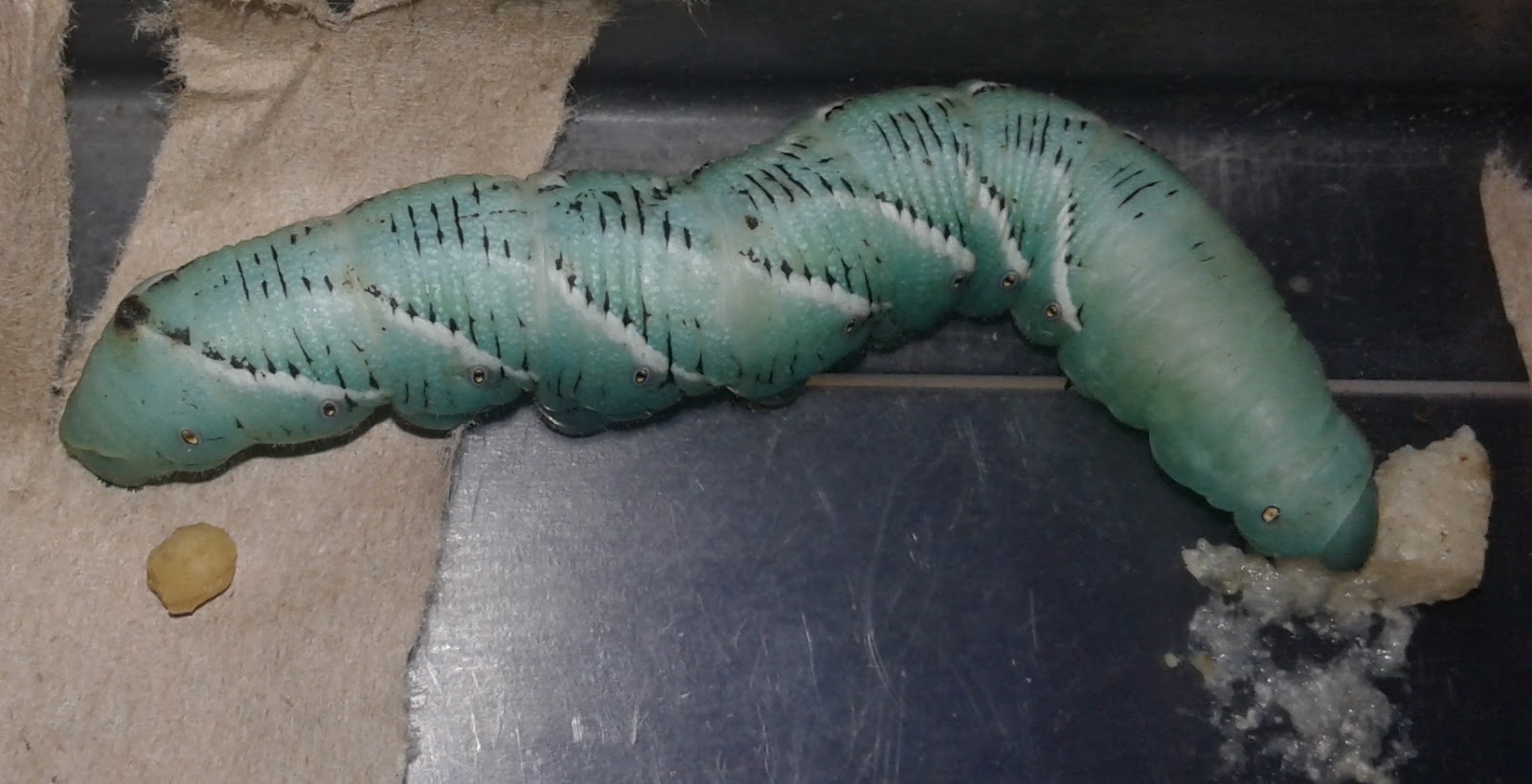 |
| In one end, out the other. Food and poop. |
Thursday, 2 February 2017
Margaret's babies live on and on and on
I am such a formative blogger, some days two or even three people look at my blog! Blogger stats tell me the referring URL's of people visiting my site. Apparently some of my readers come here via http://cuckoldqueens.com. That has to be legit right? I don't recommend clicking on that link.
You might remember my most popular post here:
http://formicidaekeeper.blogspot.ca/2016/04/margaret-and-her-babies.html
If not I will refresh your memory. Margaret the cellar spider's (Pholcus phalangiodes)
babies freely distributed themselves all over my house before I realized what was happening. And I, the person who lovingly takes each wayward fly out of my house and releases it rather than swatting it, decimated them. I just couldn't have them procreating (which as it turns out they do quite quickly and efficiently) all over my house (which doesn't belong to me and whose next occupant may not appreciate dozens of spiders everywhere).
However finding them all has proven to be quite a challenge. For a number of weeks there was a very adult looking one living in the corner of my room. I naively thought "that must be the last one, I will leave it be, it can't make babies all by itself".
Then there were two, hanging around together, because these spiders, it turns out, are more social than most spider species. And one of those two was holding onto an egg sac, which I recognize quite quickly now as the spider equivalent of a live hand grenade. I am afraid the incestuous twosome joined their siblings in oblivion.
A few weeks later my wife found one behind a chair in the living room, and I found another one in my room. Not being able to bear any more bloodshed (so to speak because it's always death by freezing, the most humane way to kill an insect or arachnid), I captured both of them and put them in critter keepers. The thinking was, of course, these MUST be the last two in the house, I could just hang onto them, they are after all very cool spiders in their own way. One of the interesting features of these spiders is if they feel threatened they will start to vibrate and bounce up and down in their web so fast that it is no longer possible to see them. This fools would-be predators into thinking they have disappeared (or that they are too crazy to bother with) and makes you feel a little dizzy trying to watch them.
But I have zero space left in my spider room, which also happens to be my office and the place where I dry out my caving gear, and the place where I put anything I don't know where else to put. Cages and containers line every horizontal surface now, and my ant colonies are sitting on top of my vinegaroon containers. So, I froze one of the last two cellar spiders (really I am sure they are the last), and in a moment of weakness and stupidity, released the other one to wander the house, in search of a mate that with my luck it will probably find, if it's not already a pregnant female. Why my wife puts up with me is a bit of a mystery. It's a good thing she is a biologist who appreciates these creatures even if she isn't terribly interested in taking care of them herself. If I ever lose her, I will be like one of those elderly single women who has a million cats, only I will be an old man with a hundred spiders instead. At least my house won't stink of cat pee.
You might remember my most popular post here:
http://formicidaekeeper.blogspot.ca/2016/04/margaret-and-her-babies.html
If not I will refresh your memory. Margaret the cellar spider's (Pholcus phalangiodes)
babies freely distributed themselves all over my house before I realized what was happening. And I, the person who lovingly takes each wayward fly out of my house and releases it rather than swatting it, decimated them. I just couldn't have them procreating (which as it turns out they do quite quickly and efficiently) all over my house (which doesn't belong to me and whose next occupant may not appreciate dozens of spiders everywhere).
However finding them all has proven to be quite a challenge. For a number of weeks there was a very adult looking one living in the corner of my room. I naively thought "that must be the last one, I will leave it be, it can't make babies all by itself".
Then there were two, hanging around together, because these spiders, it turns out, are more social than most spider species. And one of those two was holding onto an egg sac, which I recognize quite quickly now as the spider equivalent of a live hand grenade. I am afraid the incestuous twosome joined their siblings in oblivion.
A few weeks later my wife found one behind a chair in the living room, and I found another one in my room. Not being able to bear any more bloodshed (so to speak because it's always death by freezing, the most humane way to kill an insect or arachnid), I captured both of them and put them in critter keepers. The thinking was, of course, these MUST be the last two in the house, I could just hang onto them, they are after all very cool spiders in their own way. One of the interesting features of these spiders is if they feel threatened they will start to vibrate and bounce up and down in their web so fast that it is no longer possible to see them. This fools would-be predators into thinking they have disappeared (or that they are too crazy to bother with) and makes you feel a little dizzy trying to watch them.
 |
| Margaret's last surviving offspring. Maybe. Looking all creepy on my closet ceiling. |
But I have zero space left in my spider room, which also happens to be my office and the place where I dry out my caving gear, and the place where I put anything I don't know where else to put. Cages and containers line every horizontal surface now, and my ant colonies are sitting on top of my vinegaroon containers. So, I froze one of the last two cellar spiders (really I am sure they are the last), and in a moment of weakness and stupidity, released the other one to wander the house, in search of a mate that with my luck it will probably find, if it's not already a pregnant female. Why my wife puts up with me is a bit of a mystery. It's a good thing she is a biologist who appreciates these creatures even if she isn't terribly interested in taking care of them herself. If I ever lose her, I will be like one of those elderly single women who has a million cats, only I will be an old man with a hundred spiders instead. At least my house won't stink of cat pee.
Thursday, 26 January 2017
Insects, arachnids and other life I have seen in caves
 |
| Cave cricket, Vancouver Island |
 |
| Fungus growing on pack rat poo |
 |
| Moth, cave entrance near Canmore, AB |
 |
| Fungus growing on some old wood |
 | |||
| Harvestmen huddling together for warmth, near Canmore, AB |
 |
| And the occasional human visitor |
Friday, 20 January 2017
Escapes do happen - Sparassidae spp.
I have had a few escaped spiders and ant queens now. Mostly they happen when you are transferring a spider from one home to another, you expect this to happen and you can deal with them pretty quickly by having a plastic deli cup close by. Some of my escapes happened not when transferring but when the containers proved not be perfectly suited to the creature, such as my wolf spider (Hogna carolinensis) spider Fred, who pried himself between two layers of plexiglass and made a permanent escape, or my false black widow spider (Steatoda gross), Mavis who disappeared through the gap in the lid of a terrarium never to be seen or heard from again, like socks in a dryer. And there are still a few of Margaret's babies wandering around the house, if you recall one of my previous posts.
My spider room also happens to by my guest room, and more than once I have lied to house guests about having never had any escapees. There is no point in frightening people when all of my spiders are basically harmless anyway, right? Jenn, I hope you aren't reading this right now, but if you are please forgive me, nothing bad happened, right??
But yesterday's escape of my huntsman spider (Sparassidae spp.), Ginger, was particularly unique, and a little problematic. The top of Ginger's container is attached with Velcro. Usually the noise of prying off the lid is enough to send her running for cover, but yesterday for some reason, as I was flipping the lid off, she flipped herself over and somehow launched herself at the lid, then ran off of it and down the container, across the desk and up into the bucket that I keep my crickets in before I could blink. Huntsmen are stupid fast. I guess she really was hungry, because she immediately caught and started consuming a cricket. Problem was she was now in container with very rounded sides, and every time I tried to corner her with a deli container she simply ran out the gaps on the top of it, and headed for the opening, where (panicking only slightly) I scooted her back down with an energy bill. It took awhile to catch her, and in the meantime, I estimated she caught about 5 crickets and was slowly digesting them into a gooey disgusting ball.
This led me to think about how I have been feeding all of my huntsman spiders, and led to today's experiment with Huntsman #2. I have been giving these guys a cricket a day through the top of the container, and often removing the uneaten cricket the next day from the bottom. After this incident, today I took the bottom off of the other Huntsman's container, took the moist cotton out that I use as a pseudo substrate, and put about 15 crickets in there instead. Sure enough, Huntsman #2, "Nicey", descended after a few minutes and started gobbling until she also had massive gob of grossness in her mouth. I think I have been doing this all wrong, but now I know how these guys need to eat!
My spider room also happens to by my guest room, and more than once I have lied to house guests about having never had any escapees. There is no point in frightening people when all of my spiders are basically harmless anyway, right? Jenn, I hope you aren't reading this right now, but if you are please forgive me, nothing bad happened, right??
But yesterday's escape of my huntsman spider (Sparassidae spp.), Ginger, was particularly unique, and a little problematic. The top of Ginger's container is attached with Velcro. Usually the noise of prying off the lid is enough to send her running for cover, but yesterday for some reason, as I was flipping the lid off, she flipped herself over and somehow launched herself at the lid, then ran off of it and down the container, across the desk and up into the bucket that I keep my crickets in before I could blink. Huntsmen are stupid fast. I guess she really was hungry, because she immediately caught and started consuming a cricket. Problem was she was now in container with very rounded sides, and every time I tried to corner her with a deli container she simply ran out the gaps on the top of it, and headed for the opening, where (panicking only slightly) I scooted her back down with an energy bill. It took awhile to catch her, and in the meantime, I estimated she caught about 5 crickets and was slowly digesting them into a gooey disgusting ball.
 |
| Not my usual feeding protocol, at least it didn't used to be. |
 | |
| My huntsman containers, Costco food containers with the top cut out and plexiglass velcroed on. |
A ridiculously easy spider to keep, and a pleasure - Meet Steve
 |
| Steve in all his beauty |
Personality-wise, Steve is very scared. If I so much as look in his direction he retreats. Unlike my Carolina Wolf Spider, Hogna carolinensis, who would put up with being stroked by a paint brush for awhile before turning to attack it, Steve retreats if I touch him and has never turned to strike.
He builds vast sheet webs with a funnel escape in one corner. His webbing is incredibly strong, when I open the container it pulls away with an audible rip. Every day or so I spritz a little water onto his web for him to drink. I have never seen him actually drink it.
 |
| A distant cousin of Steve's, in a slightly more natural setting. |
He is a ferocious hunter, though not always immediately. It seems to take him awhile to sense that there is prey in the vicinity.
He is also a prolific pooper! I have moved him numerous times to get him away from his masses of faecal material on the floor of his various homes.
Happy Anniversary Steve!
 |
| Steve's bare bones home |
Subscribe to:
Posts (Atom)